
Recently, I picked up Heretic Kingdoms: The Inquisition, a Diablo-like action RPG where you play a young inquisitor set on destroying all traces of religion from the world. This isn’t your typical good-versus-evil narrative; instead, the game plunges you into a post-apocalyptic world where the very concept of divinity has been eradicated, leading to a society grappling with the aftermath of a “god-slaying.” The story begins with you and your master seeking a legendary sword, the very weapon that was used to kill god, initiating this world without religion. Your master, a staunch proponent of the inquisition’s radical ideology, seeks to have you destroy this sword as it, too, is a powerful reminder of the old ways, and any symbol or trace must be utterly eliminated in an inquisitor’s eyes. It’s a fascinating premise that immediately sets a somber, almost nihilistic, tone.
Quickly after starting, you learn of one of the greatest features of this game: The Dreamworld. As you explore areas in the game, you can instantly shift into a spectral “dream world” to interact with the scene in a completely different way. This isn’t just a visual filter; it transforms the environment, revealing hidden pathways, ethereal enemies, and even allowing for tactical repositioning. Something I absolutely loved was switching into the dream world to maneuver around obstacles or gain a tactical advantage in battle, then reappearing in the physical realm to attack at range from an unexpected angle. It’s a genuinely innovative mechanic that adds a layer of strategic depth not often found in ARPGs, encouraging creative problem-solving during combat and exploration.
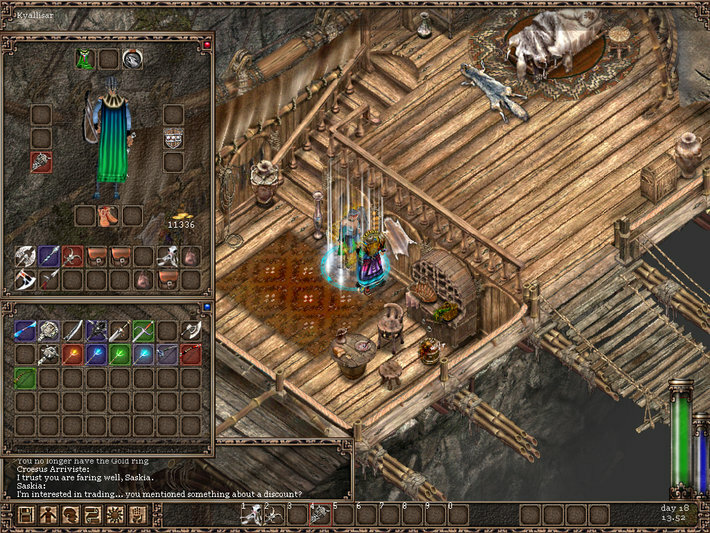
The game does show signs of its age, as the interface and the graphics are undeniably a bit rough around the edges. However, if you can look past these superficial elements, the voice acting and atmosphere are surprisingly good, imbuing the world with a sense of grim resolve. The sound design, while not groundbreaking, is serviceable and contributes to the overall immersive experience. The true draws here are the intricate spell system, the compelling, often morally ambiguous story, and of course, the unique dream world mechanic. Another significant aspect is its faction system of sorts, which lets you pick a side during key moments in the narrative. This isn’t just window dressing; your choices have real consequences, leading to one of six distinct endings depending on where you choose to place your allegiances. This encourages multiple playthroughs, as each path offers a different perspective on the shattered world and its inhabitants.
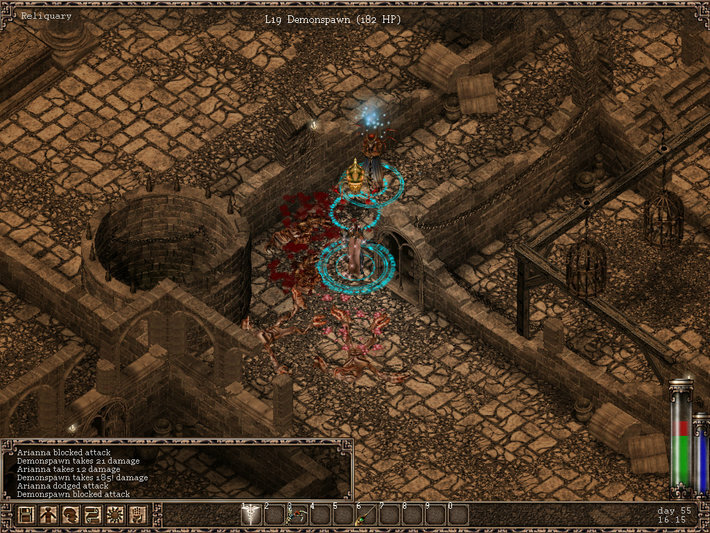
The controls were easy to pick up, a blessing in a genre that can sometimes be overly complex. The variation of loot and enemies was fun, keeping combat engaging, and the world itself continued to beckon me to explore its many secrets. The settings menu, however, was a bit barebones, and I did find myself a tad confused as to the controls of some things at times. For one, in Diablo, you can push a button and instantly see all loot on the ground. If that is possible in Heretic Kingdoms, I was unable to determine how, so I spent a fair bit of time after encounters waving my mouse over bodies to see what had fallen for me to collect. I would say if you can find the manual for this one, it should ease you in a far sight better.
Overall, I heartily recommend Heretic Kingdoms: The Inquisition if you enjoy a dark and thought-provoking storyline, intriguing gameplay mechanics, and great voice acting, as long as you can look past some of the flaws common with this era of gaming. It’s a hidden gem that rewards patience with a truly unique and memorable experience.
Get Heretic Kingdoms: The Inquisition on GOG.com (Only $0.99 as of the time of this writing!)







 CTRL ALT Review